
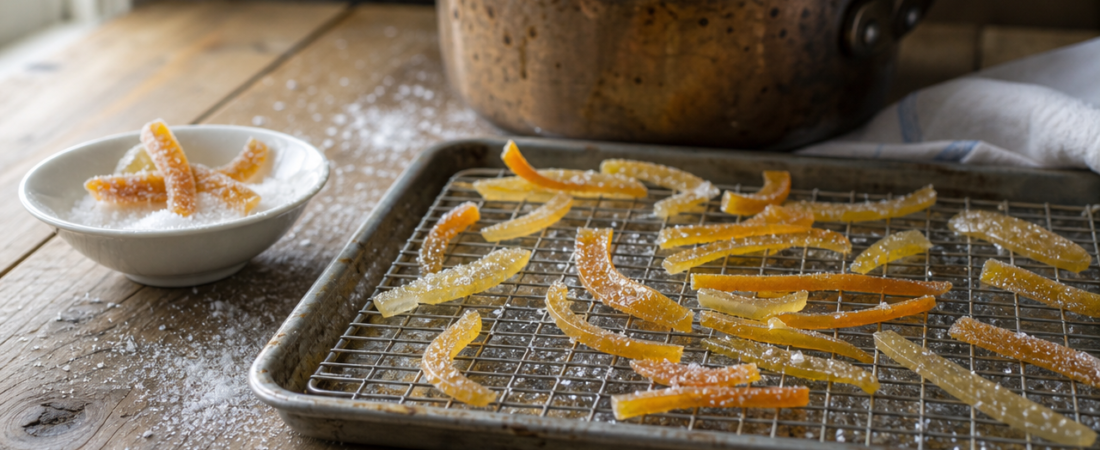
How to make candied orange peel and lemon peel at home, simmered slow and dried on a rack, the way a farmhouse kitchen did it.
The best part of a Christmas orange is the part most people throw away.
Oranges and lemons reached Prince Edward Island once a year, and a household that had paid for them used every part. The peel went into a pan with sugar and water and came out translucent, sticky and gold. Rolled in sugar and left to dry, it became the fruit that studded the cakes and puddings for the rest of the winter.
It is worth making rather than buying, and not for the reason you would expect. Shop peel is usually cut fine, dyed, and so sweet that it tastes of nothing but sugar. Peel you have candied yourself still tastes of the fruit, which is the whole point of putting it in a cake. Make it several weeks ahead, alongside the black fruitcake it goes into, and it will be ready when everything else needs it.
Candied Orange Peel and Lemon Peel
MAKES
About 2 cups
SIMMER
45 to 60 minutes
DRYING
24 to 48 hours
Ingredients
- Peel of 3 large oranges
- Peel of 2 lemons
- 2 cups granulated sugar, plus ½ cup for finishing
- 1 cup water
Method
- Score each fruit from top to bottom in quarters and take the peel off in large pieces, keeping as much of the white pith as you like. The pith softens and sweetens. It is not a fault.
- Cut the peel into strips about ¼ inch wide.
- Put the strips in a saucepan, cover generously with cold water, and bring to a boil. Boil 5 minutes, then drain.
- Repeat twice more with fresh cold water each time, three blanches in total. This is what takes the bitterness out.
- In a clean saucepan, combine 2 cups sugar with 1 cup water. Heat, stirring, until the sugar has dissolved completely.
- Add the drained peel and bring to a bare simmer.
- Cook uncovered at the gentlest possible simmer for 45 to 60 minutes, until the strips look translucent and the syrup has thickened. Do not let it boil hard or the peel will toughen.
- Lift the peel out with a fork, letting the excess syrup drain back into the pan.
- Spread the strips in a single layer on a rack set over a tray. Leave at room temperature for 24 to 48 hours, until tacky rather than wet.
- Toss the dried strips in the remaining ½ cup sugar until evenly coated.
- Store in an airtight tin.
Where candied orange peel comes from
An orange in a stocking was a real present, not a token one. It had travelled a long way to get to a winter kitchen, and nobody who had paid for it was going to put a third of it in the pig bucket.
Candying is the same preserving trick as jam, run slowly. Sugar draws the water out of the peel and takes its place, which both keeps the fruit from spoiling and concentrates what it tastes of. Every preserve works on that principle, and this is the version that fits in a tin.
The syrup left in the pan was never thrown out either. It was bottled and used to sweeten a drink or to moisten a plain cake, and it is worth keeping for the same reasons.
In a modern kitchen
Three blanches is the number, and it is the step people skip. Two leaves a bitterness that carries through into everything you put the peel in. Four starts washing out the citrus oil that is the entire reason for making it.
A bare simmer means the occasional lazy bubble. A rolling boil drives the sugar into the peel too fast and sets it hard, and no amount of further cooking will soften it again.
The drying cannot be hurried in a warm oven. The outside hardens while the middle stays wet, and it will mould in the tin inside a fortnight with nothing showing on the surface to warn you. A rack, a tray and two days of ordinary room air is all it wants. This is the part of the six-week Christmas baking timeline that has to be started first, because everything else waits on it.
How long it keeps
- Cool room: 3 months in an airtight tin
- Refrigerated: Not needed
- Frozen: Not needed
It is the sugar that preserves it, so do not reduce the sugar and expect it to keep.
Making this to give away?
Candied peel is one of the few sweets that travels well. The Cottage Christmas Gift Kit covers how far ahead to make things, what survives a parcel, and printable gift tags and tin labels. Free, four pages.