
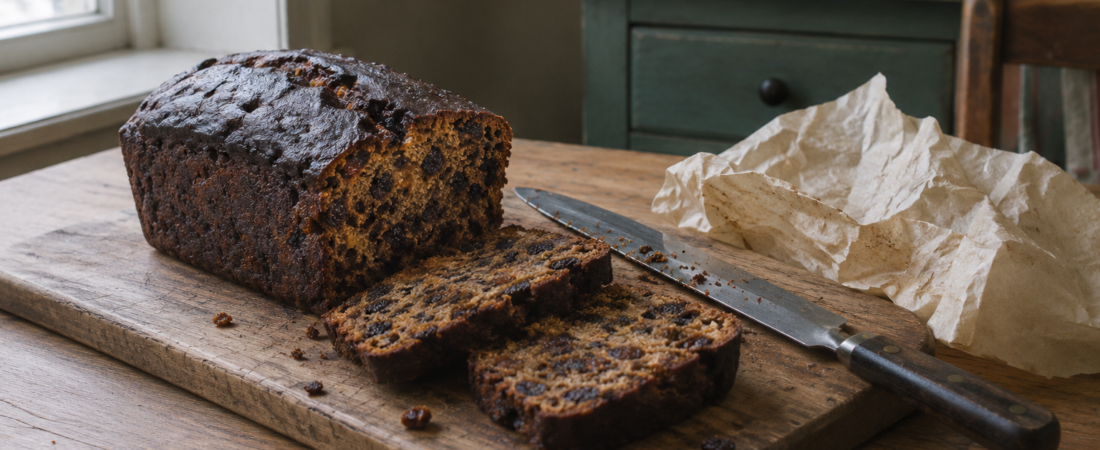
A dark, dense old-fashioned Christmas fruitcake, built six weeks before the day and left alone to improve.
Some cakes are made to be eaten. This one is made to be kept.
A black fruitcake is built in November and not cut until it has to be. It is dark almost to the point of severity, dense with raisins and currants and peel, and it improves in a cool cupboard while everything around it is consumed and replaced. A household that has one put by is a household that is ready for whatever the season brings.
Marilla kept such a cake, well aged and deeply spiced, and brought it out in neat slices for callers. That was the whole point of it. A fruitcake was not a treat so much as a standing declaration that this kitchen could receive anyone, at any hour, without being caught short. It is the first thing on the six-week Christmas baking timeline, and everything else follows from it.
Old-Fashioned Christmas Fruitcake
MAKES
One 9×5-inch loaf, 24 thin slices
OVEN
300°F / 150°C / gas 2
TIME
2 to 2¼ hours
Ingredients
- ¾ cup raisins
- ½ cup currants
- ½ cup dried figs, chopped small
- ⅓ cup candied peel, chopped
- Grated zest of 1 orange
- 1¼ cups all-purpose flour
- ½ teaspoon baking powder
- ¼ teaspoon baking soda
- ½ teaspoon salt
- 1½ teaspoons ground cinnamon
- ¾ teaspoon ground nutmeg
- ½ teaspoon ground cloves
- ½ teaspoon ground allspice
- ½ cup unsalted butter, softened
- ¾ cup packed dark brown sugar
- 3 large eggs
- 3 tablespoons molasses
- 2 tablespoons milk
Method
- Grease a 9×5-inch loaf pan and line the base and long sides with parchment, leaving an overhang.
- Preheat oven to 300°F (150°C).
- In a bowl, combine raisins, currants, figs, candied peel, and orange zest. Add 2 tablespoons of the measured flour and toss until the fruit is lightly coated. This keeps it from sinking.
- In a second bowl, whisk the remaining flour with baking powder, baking soda, salt, and all four spices.
- In a large bowl, beat butter and brown sugar together until light, about 4 minutes.
- Add eggs one at a time, beating well after each. Beat in the molasses.
- Add the flour mixture in two additions, alternating with the milk, mixing only until no dry flour remains.
- Fold in the floured fruit by hand.
- Spoon into the prepared pan and level the top. The pan should be no more than two-thirds full.
- Bake 1 hour, then lay a sheet of foil loosely over the top to stop the surface darkening further.
- Continue baking 1 to 1¼ hours more, until a skewer pushed into the center comes out clean.
- Cool in the pan for 30 minutes, then lift out by the parchment and cool completely on a rack before wrapping.
Where the old-fashioned Christmas fruitcake comes from
The black fruitcake came to the Maritimes from Britain and stayed because it suited the conditions. Dried fruit, molasses, and spice all kept without refrigeration, and a cake built almost entirely from them would sit in a cupboard for weeks without deteriorating. In a household that might receive callers at any hour of a long winter, that was worth a great deal.
Molasses does more here than darken the crumb. It is hygroscopic, meaning it holds on to water, and a cake built around it stays moist for weeks after a cake sweetened only with white sugar has dried out. The color is the visible part of that; the keeping is the reason.
Cakes of this kind were traditionally fed with brandy every few weeks, which is what allowed them to be kept for months rather than weeks.
In a modern kitchen
The low oven and the long bake are not optional. 300°F is what an old recipe means by a slow oven, and a fruitcake baked hotter will have a burned crust and a raw center before the middle has come up to temperature.
Wrap it well, in parchment and then foil, and leave it alone. It genuinely improves over the first fortnight, and cutting into it early is the one thing that cannot be undone.
Older recipes promise months on an open shelf. Those cakes were fed with spirits, which is what did the preserving. Go by the times below instead.
Do not brush the cake with sugar syrup in place of feeding it. Syrup adds moisture without adding anything that preserves, and it shortens the cake’s life rather than extending it.
How long it keeps
- Cool room: 3 weeks, wrapped in parchment then foil. It improves over the first fortnight.
- Refrigerated: 2 months
- Frozen: 6 months, whole or in slices
Baking this for somebody else?
The Cottage Christmas Gift Kit covers the part no recipe does: how far ahead to make it, what survives a parcel, plus printable gift tags and tin labels. Free, four pages.
This recipe is one of forty-one in Christmas at Green Gables, which runs from the first cake of November through to the New Year. Everything on this site is written the same way it appears in the book.