
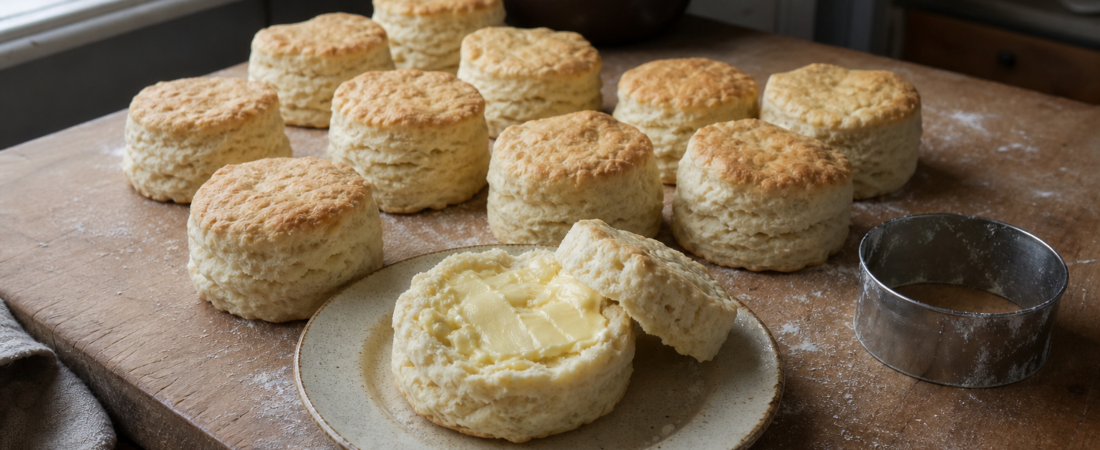
Old-fashioned tea biscuits, in the oven before the kettle sings, and light rather than heavy.
There are few things more reassuring than the sound of a biscuit tin being opened in the late afternoon.
Tea on the Island was not ceremony for its own sake. It marked a pause between labors. Boots were left by the door, hands were washed, and the kettle was set to boil. It made no difference whether the weather brought a damp spring thaw, high summer brightness, or a sharp autumn wind. There was comfort in something warm and newly baked.
Tea biscuits required no yeast and no long patience. They could be mixed and in the oven before the teapot began to sing. Their simplicity was their virtue. Flour, butter, milk: nothing extravagant, nothing wasted.
Old-Fashioned Tea Biscuits
MAKES
10 to 12 biscuits
OVEN
425°F / 220°C / gas 7
TIME
12 to 15 minutes
Ingredients
- 2 cups all-purpose flour
- 1 tablespoon baking powder
- ½ teaspoon salt
- 1 tablespoon granulated sugar, optional but traditional in many households
- ½ cup cold unsalted butter
- ¾ cup whole milk
Method
- Preheat oven to 425°F (220°C). Line a baking sheet or leave ungreased.
- In a large bowl, whisk together flour, baking powder, salt, and sugar.
- Cut cold butter into small cubes. Work into the flour mixture with fingertips or a pastry cutter until the texture resembles coarse crumbs with small visible pieces of butter.
- Make a well in the center and pour in milk. Stir gently with a fork just until a soft dough forms. Do not overmix.
- Turn dough onto a lightly floured surface. Pat gently to ¾-inch thickness. Fold once or twice for light layering, then pat again.
- Cut with a round cutter, pressing straight down without twisting.
- Place biscuits on the baking sheet. For softer sides, arrange close together. For crisper edges, space slightly apart.
- Bake 12 to 15 minutes, until risen and lightly golden. Serve warm.
Where old-fashioned tea biscuits come from
Tea biscuits in Prince Edward Island kitchens were quick breads leavened with baking powder rather than yeast. By the late nineteenth century, commercial baking powder had become widely available, making such recipes dependable and efficient.
They were typically served plain, split and buttered, or accompanied by preserves put up earlier in the season. Unlike sweeter confections, tea biscuits were considered everyday fare, practical sustenance rather than indulgence.
The technique mattered more than the ingredient list. Overhandling the dough produced toughness, and experienced cooks learned to mix with restraint. Lightness was regarded as proof of skill.
In a modern kitchen
The butter must be cold. Those small visible pieces are what make the biscuit rise in layers rather than in one solid block.
Press the cutter straight down. Twisting seals the cut edge and the biscuit rises lopsided or not at all.
A hot oven is the other half of it. 425F is what an old recipe means by hot, and biscuits want that heat from the moment they go in.
How long it keeps
- Cool room: 2 days, airtight. Best warm from the oven.
- Refrigerated: Not needed
- Frozen: 1 month
Struggling to read an old recipe?
How to Read an Old Recipe translates the vague bits: old measures converted, oven descriptions in real degrees, and the instructions that leave something out. Free, two printable pages.
This recipe is one of forty-seven in The Green Gables Kitchen Companion, arranged across four seasons of a Prince Edward Island year. Everything on this site is written the same way it appears in the book.