
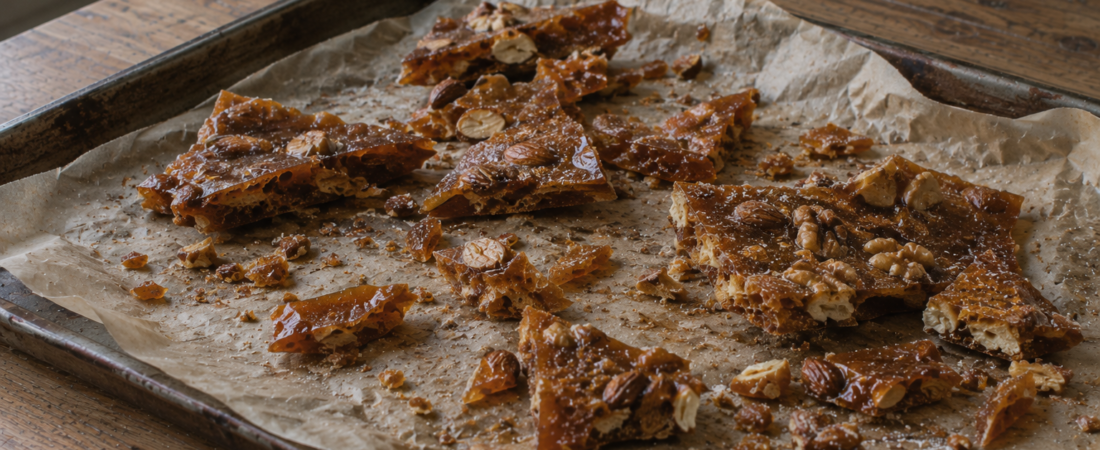
Old-fashioned nut brittle, boiled to the hard crack and lifted with a spoonful of baking soda so it shatters instead of shattering your teeth.
Brittle is sugar work at its most direct. Boil, add nuts, pour, cool, break.
The only real skill is knowing when to stop cooking. Too early and it stays tacky and pulls at the teeth. Too late and the sugar scorches and turns bitter, and nothing rescues it once it has. A thermometer removes the guesswork, and there is no reason not to use one.
Nuts were bought in at Christmas and rationed carefully through the winter, so a batch of brittle was a real decision about how to spend them. It was usually judged worth it. If you have already made the chocolate caramels, you have done the harder of the two.
Old-Fashioned Nut Brittle
MAKES
About 1¾ pounds
BOIL TO
300 to 310°F, hard crack
COOL
1 hour, untouched
Ingredients
- 2 cups granulated sugar
- ½ cup water
- ½ cup light corn syrup
- 2 cups mixed nuts (almonds, walnuts, hazelnuts), roughly chopped
- 2 tablespoons unsalted butter
- ½ teaspoon salt
- 1 teaspoon baking soda
Method
- Line a large rimmed baking sheet with parchment and butter it. Have it ready before you begin.
- Measure the butter, salt, and baking soda into a small dish and set it beside the stove. Once the sugar is up to temperature there is no time to fetch anything.
- Combine sugar, water, and corn syrup in a deep heavy saucepan. Set over medium heat and stir until the sugar has dissolved completely.
- Stop stirring. Clip on a candy thermometer and boil to 280°F.
- Stir in the chopped nuts.
- Continue cooking, stirring constantly now so the nuts do not catch, until the thermometer reaches 300°F to 310°F, the hard crack stage, and the syrup has turned deep amber.
- Off the heat, add the butter, salt, and baking soda all at once and stir hard for about 5 seconds. The mixture will foam up pale and double in volume.
- Pour immediately onto the prepared sheet and spread thin with a buttered spatula, working fast.
- Leave to cool completely, at least 1 hour. Do not touch it while warm.
- Break into irregular pieces.
What makes old-fashioned nut brittle brittle
The baking soda, and nothing else. Added to hot sugar it releases carbon dioxide instantly, and the bubbles are trapped as the candy sets, leaving a honeycombed structure riddled with air.
Leave it out and you have a slab of clear hard candy with nuts in it, which snaps like glass and eats like glass. With it, the same sugar shatters cleanly and dissolves on the tongue. That is also why the pan turns from amber to pale gold in those five seconds of stirring. The colour change is the air going in.
Brittle belongs to a large family of nut and sugar confections found wherever both were available. The Maritime version was distinguished mainly by using whatever nuts had actually been bought that year rather than any fixed combination.
In a modern kitchen
Have everything ready before the sugar goes on the heat. From 280°F onward this recipe gives you no time at all, and stopping to find the baking soda will cost you the batch.
Spread it thinner than feels right. Brittle poured thick is genuinely hard to eat and harder to break neatly.
Do not scrape the saucepan out onto the sheet. What clings to the bottom is the most cooked part and carries a burnt note into everything around it.
Brittle is a late job rather than an early one. It keeps three weeks and no longer, so on the six-week Christmas baking timeline it belongs in the fortnight before, alongside the cookies, not in November with the cake.
How long it keeps
- Cool room: 3 weeks, airtight, with waxed paper between the layers
- Refrigerated: Not needed
- Frozen: Do not freeze
Humidity ends brittle long before time does. A damp kitchen will turn it sticky in days.
Boxing this up for somebody?
Brittle travels well if it is kept dry and layered with waxed paper. The Cottage Christmas Gift Kit covers how far ahead to make each thing, what survives a parcel, and printable gift tags and tin labels. Free, four pages.