
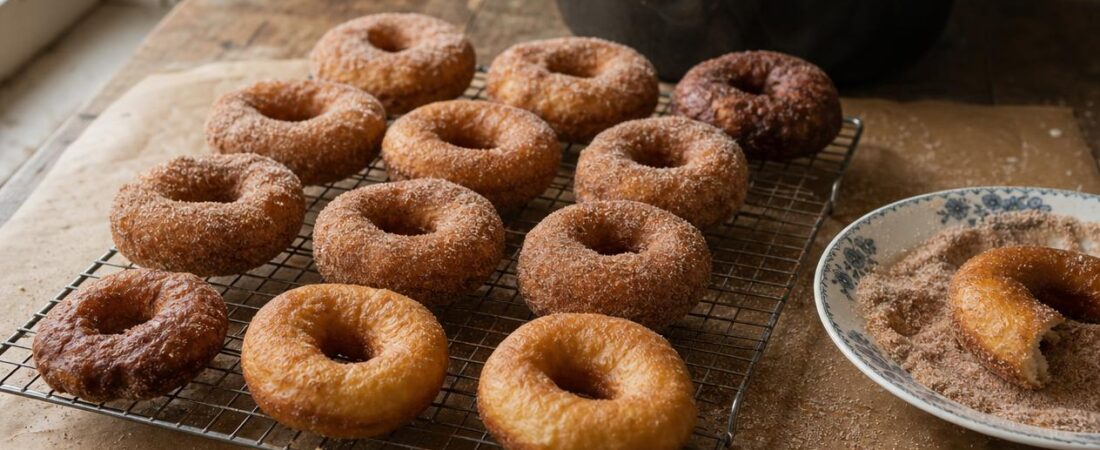
Old-fashioned doughnuts raised with baking powder rather than yeast, fried in a deep pot and rolled in cinnamon sugar while they are still too hot to hold.
This is not the light ring from a bakery counter. It is closer to cake than to bread, and it is meant to be.
Frying was an event. A heavy pot of fat was brought up to heat and the entire batch went through in quick succession, because nobody was going to do this twice in one week. They came out onto brown paper, were rolled in sugar while the steam was still coming off them, and were eaten by whoever happened to be standing nearest the stove. That is still the correct way to eat them.
In the novels, doughnuts turn up at the tea Mrs Barry lays on to put things right after the raspberry cordial disaster, set out with pound cake and two kinds of preserves. It was an apology in the form of a table, and it worked. If your morning would rather have something yeasted and slow, the cinnamon rolls that rise overnight are the other half of this tradition.
Green Gables Doughnuts
MAKES
About 18 doughnuts and 18 holes
OIL
365 to 370°F / 185 to 188°C
CHILL
1 hour, not negotiable
Ingredients
FOR THE DOUGHNUTS
- 3½ cups all-purpose flour
- ¾ cup granulated sugar
- 3½ teaspoons baking powder
- 1 teaspoon salt
- 1 teaspoon ground nutmeg
- ½ teaspoon ground cinnamon
- 2 large eggs
- ¾ cup whole milk
- ¼ cup unsalted butter, melted and cooled
- 1 teaspoon vanilla extract
- Neutral oil, for frying
FOR ROLLING
- ½ cup granulated sugar
- 1 tablespoon ground cinnamon
Method
- In a large bowl, whisk together flour, sugar, baking powder, salt, nutmeg, and cinnamon.
- In a second bowl, whisk the eggs, then whisk in the milk, melted butter, and vanilla.
- Pour the wet mixture into the dry and stir until a soft, sticky dough forms. Do not knead it.
- Cover and refrigerate at least 1 hour. This dough cannot be rolled warm.
- Stir the rolling sugar and cinnamon together in a shallow dish and set it beside the stove with a wire rack.
- Pour 2 to 3 inches of oil into a heavy deep pot and bring it to 365 to 370°F.
- Meanwhile, turn the chilled dough onto a well-floured surface and pat or roll it to ½ inch thick.
- Cut with a floured 3-inch doughnut cutter, or a 3-inch round cutter with a 1-inch cutter for the centers. Gather and re-roll the scraps once.
- Lower 3 or 4 doughnuts into the oil, never crowding the pot. The temperature will drop. Let it recover between batches.
- Fry 1 to 1½ minutes a side, until deep golden. Turn once only.
- Lift onto the wire rack with a slotted spoon.
- Roll in the cinnamon sugar while still hot. Sugar will not stick to a cooled doughnut.
- Fry the holes last. They take about a minute in total.
What makes an old-fashioned doughnut different
A cake doughnut rises on baking powder instead of yeast, and that one difference explains everything else about it. There is no proving, no waiting and no second rise, which is exactly why it suited a morning when the kitchen had other commitments. The trade is texture: dense and tender rather than light and chewy.
The nutmeg is not a flourish. Warm spice in a fried dough is old practice, common enough in nineteenth-century recipes that its absence is more surprising than its presence, and nutmeg in particular is what makes the difference between something that tastes like a doughnut and something that tastes like fried dough.
The whole batch went through in one sustained session for a practical reason. Bringing a large pot of fat up to heat cost both money and most of an hour, so once it was hot, everything that could be fried was fried.
In a modern kitchen
Watch the temperature more than the clock. Below 360°F the doughnut sits in the fat absorbing it instead of sealing on contact, and comes out heavy and greasy. Above 375°F it colors before the center has set, and you find raw dough inside something convincingly brown. Three or four at a time, and let the oil climb back between batches, because every addition drops it.
The chill is not optional. Warm dough cannot be lifted off the counter in one piece, and it drinks oil in the pot.
Drain on a wire rack, not on paper. Paper traps steam underneath and softens the crust you have just spent two minutes building. And roll them in sugar the moment they come out, because by the time you have finished the last batch, nothing will stick.
How long it keeps
- Best within the hour. That is not a figure of speech
- Cool room: 2 days airtight, honestly past their best
- Refrigerated: Not needed, and it makes them worse
- Frozen: Do not freeze
Struggling to read an old recipe?
How to Read an Old Recipe translates the vague bits: old measures converted, oven and fat temperatures in real degrees, and the instructions that leave something out. Free, two printable pages.
Christmas morning has a whole section to itself in Christmas at Green Gables: bread, hot fat and an early fire, five recipes for the one meal of the year nobody wants to be cooking from scratch.