
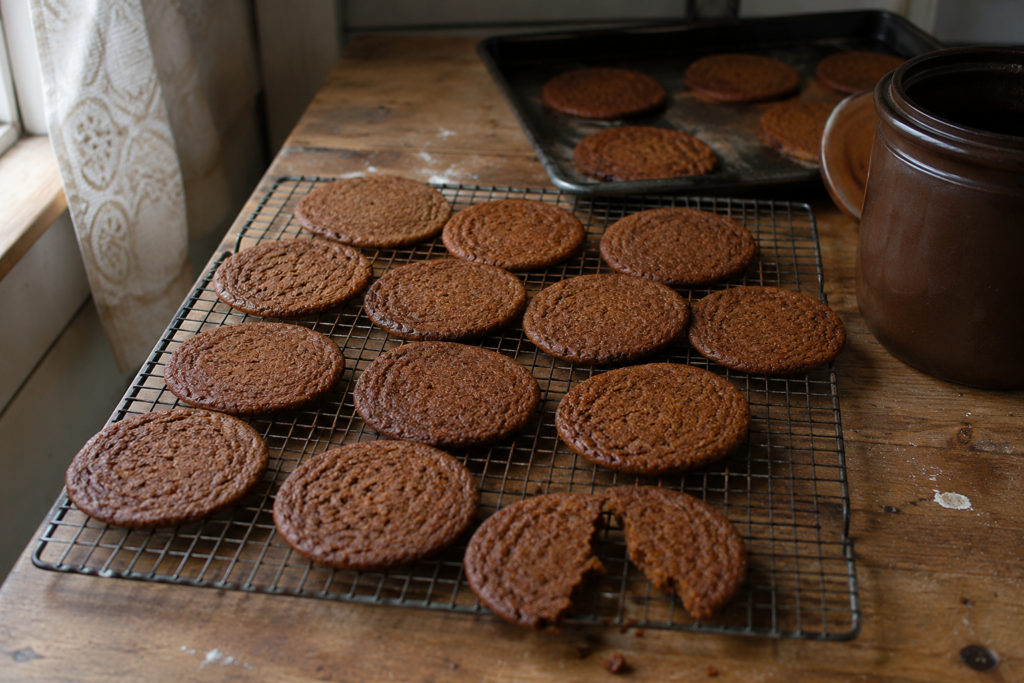
Old-fashioned molasses cookies, exactly as a Prince Edward Island farmhouse made them: firm, dark, and baked by the dozen.
If one cookie could be said to belong to the Maritimes, this is it.
These are firm, dark, and generously spiced, rolled thin and cut into rounds, and they were made in quantities that seem alarming until you remember how many people passed through a farmhouse in a week. A batch was measured in dozens and stored in something with a lid.
They also travel. A molasses cookie survives a coat pocket, a sleigh ride, and an evening in a crowded schoolhouse without falling apart, which is more than can be said for most baking.
Old-Fashioned Molasses Cookies
MAKES
About 4 dozen 3-inch cookies
OVEN
350°F / 175°C / gas 4
TIME
8 to 10 minutes, plus chilling
Ingredients
- ¾ cup unsalted butter, softened
- ¾ cup packed brown sugar
- ½ cup molasses
- 1 large egg
- 3½ cups all-purpose flour
- 1 teaspoon baking soda
- ½ teaspoon salt
- 2 teaspoons ground ginger
- 1 teaspoon ground cinnamon
- ½ teaspoon ground cloves
- ¼ teaspoon ground nutmeg
Method
- In a bowl, whisk together flour, baking soda, salt, ginger, cinnamon, cloves, and nutmeg.
- In a large bowl, beat butter and brown sugar until light, about 3 minutes.
- Beat in the molasses, then the egg.
- Add the flour mixture in three additions, stirring until a stiff dough forms.
- Divide the dough in two, flatten each half into a disc, wrap, and chill at least 2 hours or overnight. The dough must be cold to roll cleanly.
- Preheat oven to 350°F (175°C). Line two baking sheets with parchment.
- Working with one disc at a time and leaving the other chilled, roll on a lightly floured surface to ⅛ inch thick.
- Cut into 3-inch rounds and lift onto the prepared sheets, spacing 1 inch apart. These barely spread.
- Gather and re-roll the scraps once. Dough rolled a third time turns tough.
- Bake 8 to 10 minutes, until the surface looks dry and the edges are firm.
- Cool on the sheet 3 minutes, then transfer to a rack. They crisp as they cool.
Where old-fashioned molasses cookies come from
Rolled and cut molasses cookies were standard provisioning baking. They were made in very large batches, stored in tins or stoneware crocks, and drawn on for weeks: given to children walking to school, carried on sleigh journeys, and set out whenever anyone called.
The spicing is heavier than a modern palate expects, and that is not an error in the recipe. Ground spice loses its volatile oils steadily once it is opened, and a nineteenth-century household buying loose spice and keeping it in a paper twist through a long winter was working with something considerably weaker by February than what comes out of a sealed jar today. Period recipes compensate with quantity.
Cookie cutters were made locally by tinsmiths, often from scrap, which is why so many surviving Maritime examples are plain rounds and simple shapes rather than anything elaborate.
In a modern kitchen
These are meant to be firm and snappy, not soft. If you prefer a chewier cookie, roll to ¼ inch and take them out at 8 minutes, but they will not keep as long.
The dough must be properly cold. Warm molasses dough sticks to everything, tears when lifted, and needs so much extra flour to manage that the cookies turn dry.
How long it keeps
- Cool room: 3 weeks, airtight. They improve in the tin for the first few days as the spice settles.
- Refrigerated: Not needed
- Frozen: 3 months, as raw dough discs
Struggling to read an old recipe?
How to Read an Old Recipe translates the vague bits: old measures converted, oven descriptions in real degrees, and the instructions that leave something out. Free, two printable pages.
This recipe is one of forty-one in Christmas at Green Gables, which runs from the first cake of November through to the New Year. Everything on this site is written the same way it appears in the book.