
About this kitchen
Old-fashioned cottage cooking, properly written down.
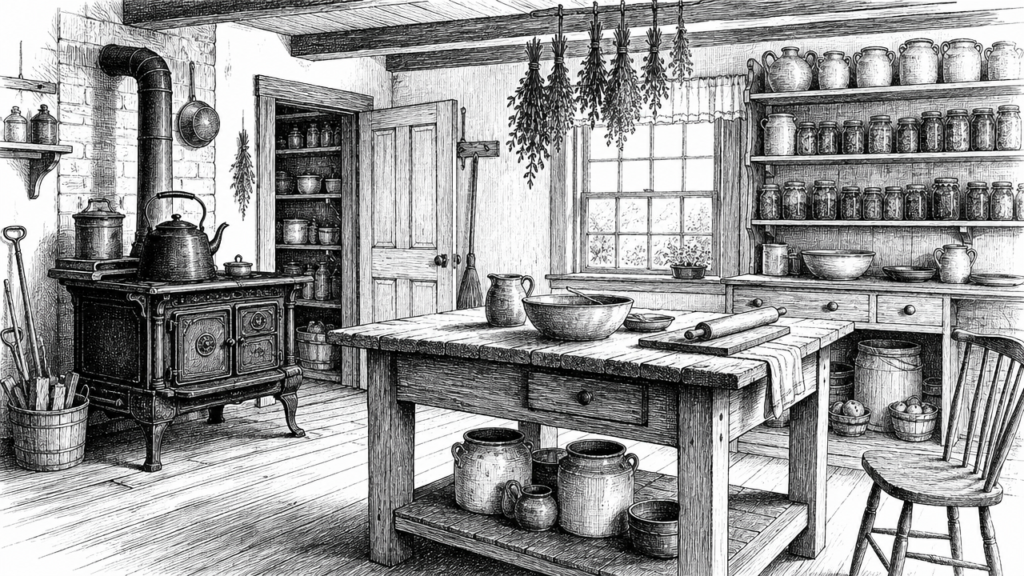
Most old recipes are close to unusable as they are written. They assume you know what a moderate oven means, that you can judge butter by the size of an egg, and that you have a cold pantry rather than a refrigerator. So they get skipped, and the cooking that went with them gets lost, which is a shame, because a great deal of it was very good.
The work here is putting them back into a form you can actually cook from, without flattening what made them interesting in the first place. Turn-of-the-century farmhouse cooking, mostly Prince Edward Island and the world of Anne of Green Gables, made usable again.
The old way was a system
Fruit was put up in July because December was coming. Cakes were made in November because they needed the time. Puddings were steamed because ovens were unreliable and fuel cost money. A farmhouse kitchen ran on a calendar rather than on impulse, and that calendar is the actual content.
This is why the history is not decoration. Once you know the constraint behind a method, the recipe stops looking eccentric and starts making sense. That is the part most old-fashioned cookbooks leave out, and it is the part that makes the difference between reading a recipe and understanding it.
How every recipe is written
Five parts, in the same order, in the books and on this site.
- A headnote. Where the dish came from and why it mattered.
- Ingredients, converted to standard cups and weights, with a stated yield.
- Method, numbered, complete, nothing assumed.
- Historical context. The technique and the constraint behind it, not just the era.
- A modern kitchen note. What changed for a modern oven, what tends to go wrong, and how long it keeps at room temperature, refrigerated and frozen.
That last part is the one nobody else bothers with. Every recipe answers all three keeping questions, because it is the question every cook actually asks and no book answers in one place.
The recipes are checked. Ratios against known-reliable proportions, canning against current safety guidance, keeping times stated rather than implied. Home canning in particular is the one kitchen job where being wrong is dangerous rather than disappointing, so it gets treated that way.
The books
Two cookbooks, written by Ida Marsh and built as a pair.
The Green Gables Kitchen Companion, second edition, is the everyday book. Forty-seven recipes across four seasons of a Prince Edward Island year: spring greens and tea biscuits, summer preserves, autumn apples, winter suppers.
Christmas at Green Gables is the seasonal book. Forty-one recipes across eight sections, from the first cake of November to the New Year, covering the six weeks the Companion leaves out.
Nothing in one repeats anything in the other. That is deliberate, and it is printed in both.
Who is behind it
The Cottage Kitchen Table is a small operation. Small in the literal sense: no test kitchen and no team, just a lot of reading of old cookbooks and a fair amount of time spent working out what a quick oven meant to someone who never owned a thermometer.
I would rather the recipes spoke for themselves. The working out gets written down too. Notes from the kitchen is where the reasons live: what a moderate oven actually means, why Christmas cake is made in November, and how a farmhouse kept food through winter with no refrigerator at all.
If something here does not work, or you know more about it than I do, I would like to hear about it.
Write to [email protected]. I read everything, though I do not always answer quickly.
Start with the recipes
Free to read, free to print, and none of them ask for anything.