
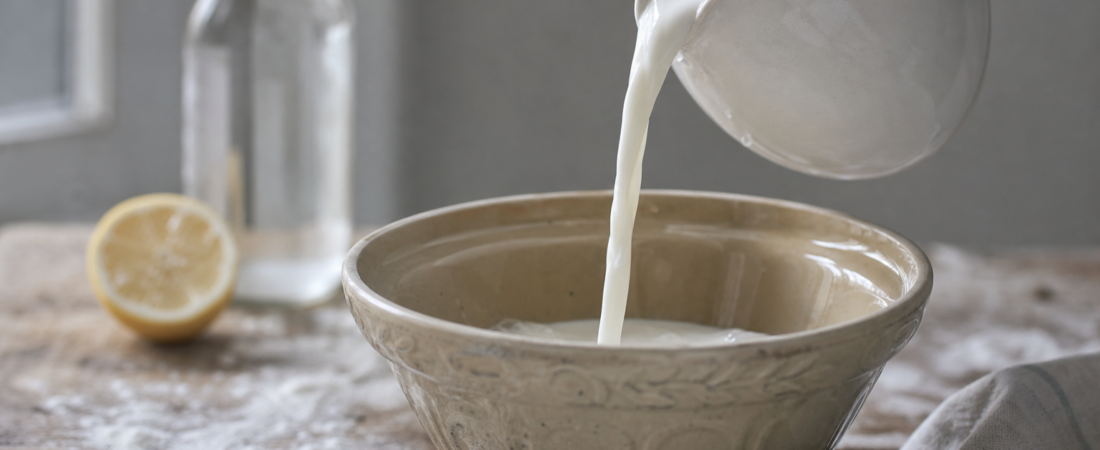
How to make sour milk from what is already in the kitchen, and why an old recipe asks for it instead of the milk in your fridge.
One tablespoon of lemon juice or white vinegar stirred into one cup of milk, left to stand for ten minutes. That is the whole answer, and it takes longer to read this sentence than to do it.
The reason the instruction exists at all is that old recipes were written for kitchens where sour milk was simply present. Nobody made it. It arrived, daily, whether anyone wanted it or not.
A farmhouse with a cow had more milk than it could drink, standing in a cool pantry in open pans while the cream rose. Some of it turned before it was used. And every time butter was churned, a jug of thin, sharp buttermilk was left behind, too useful to pour away. A cook reaching for sour milk was using up what she already had, not shopping for an ingredient.
How to make sour milk, three ways
All three do the same job. Use whichever is already open.
| For 1 cup of milk | Add | Stand |
|---|---|---|
| Lemon juice | 1 tablespoon | 10 minutes |
| White vinegar | 1 tablespoon | 10 minutes |
| Buttermilk, if you have it | Use it cup for cup instead | None |
Stir once, then leave it alone. After ten minutes it will look slightly thickened and faintly grainy at the edge of the jug. That is correct and it is what you want. Do not whisk the lumps out; they are the point.
Whole milk gives the closest result. Skimmed works and tastes thinner, which matters in a plain cake and not at all in a pan of buttermilk pancakes.
Why the recipe wants it
Three things, and the first is the one that will ruin your baking if you ignore it.
Baking soda needs an acid to work. On its own it does very little except taste of itself. Give it something sour and it fizzes, and that fizz is what lifts the crumb. A recipe pairing soda with sour milk is not offering you two ingredients, it is describing one reaction.
Acid makes a softer crumb. It shortens the strands of gluten that would otherwise make a cake chewy, which is why a sour-milk cake is tender in a way a plain-milk one is not.
And it tastes of something. A faint tang underneath the sugar, which is most of the difference between an old cake and a modern one, and the reason people say old recipes taste less sweet without being able to say why.
The one substitution that does not work
If the recipe lists baking soda, do not use plain milk and hope. With nothing sour to react with, the soda sits there: the cake comes out flat, slightly grey in the crumb, and carries a soapy, metallic aftertaste that people usually blame on the recipe being old. It is a thirty-second fix and it is not optional.
Do not just leave milk on the counter
This is the part that has changed since the recipe was written, and it is worth being plain about.
Raw milk from a cow carries the bacteria that turn it sour. Left in a cool pantry it thickens, sharpens and sets into something a cook could use, which is what happened in the kitchens these recipes came from.
Milk from a carton has been pasteurised, so those bacteria are gone. Left out, it does not sour. It spoils, which is a different process with a different smell, and the result belongs in the sink rather than in a cake. Add the acid yourself and you get in ten minutes what a pantry used to do overnight, without the gamble.
The one genuinely traditional version still open to you is the real thing: churn a little cream, keep what is left behind, and use that. It takes about ten minutes and makes you butter at the same time.
Struggling to read an old recipe?
How to Read an Old Recipe translates the vague bits: old measures converted, oven descriptions in real degrees, and the instructions that leave something out. Free, two printable pages.
More of this sort of thing is in the cookbooks, where every recipe carries the history that explains why it is made that way.