
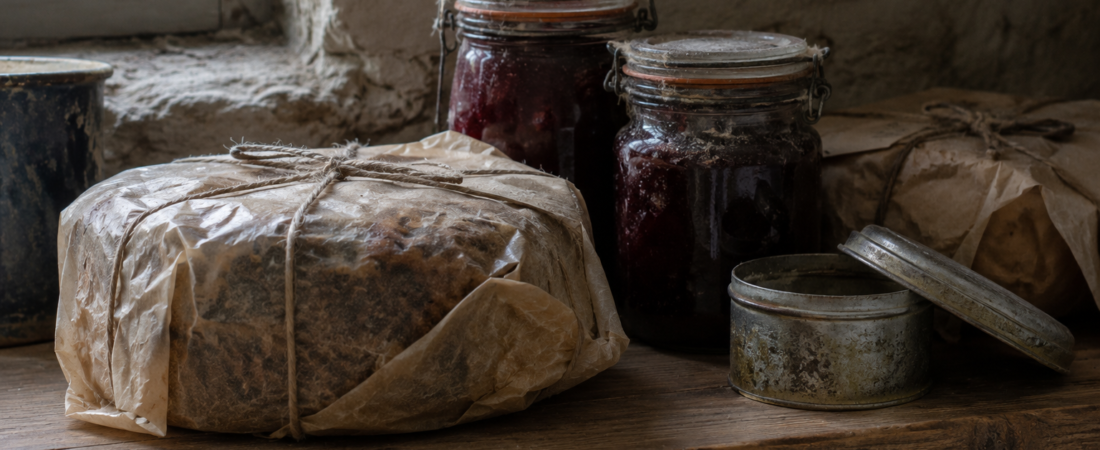
When to start Christmas baking, counted backward from the day across six weeks, with the reason each thing sits where it does.
Every instruction in an old Christmas recipe that looks fussy is really a scheduling instruction. Make the cake in November. Candy the peel over five days. Boil the sweets three weeks out. None of it is ceremony. It is a household with one oven working out the only order that fits.
So the honest answer to when to start Christmas baking is six weeks out, and the calendar below is counted in weeks rather than dates, because your December is not theirs and the fruit decides anyway.
The Christmas baking timeline, week by week
Six phases, counted back from the twenty-fifth. Nothing here is decoration: each thing sits where it does because of how long it keeps and how much oven it needs.
Six weeks out: the cakes
The black fruit cake and the rich iced cake are made now and then left alone. A fruit cake leaves the oven with its liquid unevenly held, wet fruit against a drier crumb, and it takes weeks wrapped and cool for the water to move through and even out. The spices need the same time to stop reading as separate notes.
This is also the moment for candied peel and candied cherries, which want five slow days of their own and go into the cake. If you are making everything from scratch, peel comes before cake.
Five weeks out: preserves and anything given away
Jams, jellies and marmalade, made now so they have time to seal properly and be labelled without a rush. A household with no money to spend gave what it had put up, and the giving was planned as carefully as the making.
This is the one part of an old Christmas where the modern rules genuinely differ. Fruit, jams, jellies and properly acidified pickles are fine in a boiling water bath. Anything low-acid needs a pressure canner, and old open-kettle methods should be set aside.
Three weeks out: sugar-boiled sweets
Caramels, brittle, hard candy, taffy. Everything that is boiled to a stage on a thermometer and then left to set. Three weeks is comfortably inside their keeping time and gets the messiest job out of the way while the kitchen is still calm.
Wrap caramels individually as they are cut. Left loose in a tin they find each other and arrive as one caramel.
Two weeks out: puddings and rolled cookies
Steamed puddings, hermits, and any cookie that is rolled and cut. Rolled doughs want chilling and cutting time, and a steamed pudding wants a long unhurried afternoon rather than a stolen hour.
Molasses cookies belong here and keep three weeks airtight, improving for the first few days as the spice settles.
The week itself: breads, gingerbread, most cookies
Pound cake, gingerbread, brown bread, raisin bread, and the cookies that are better fresh. These are quick, forgiving and best eaten within days, so there is no reason to make them earlier and every reason not to.
Christmas Eve: anything that needs a night
Enriched doughs and set puddings. Cinnamon buns are mixed and shaped now and left cold overnight, so the morning needs half an hour rather than three. Snow pudding and anything that has to set goes in tonight.
The day itself: anything fried or eaten hot
Doughnuts, fritters, and whatever is best straight out of the fat. Nothing here can be made ahead, which is exactly why everything else was.
So when should you start Christmas baking?
Six weeks before the day, with the fruit cake. Everything else follows from that one date, and the further down this list a thing sits, the closer to Christmas it wants making.
The short version
A farmhouse Christmas baking timeline was not three days long. It ran over six weeks, in the order one oven allowed, with the things that keep made first and the things that do not made last.
Planning it on paper?
The Cottage Christmas Gift Kit has the make-by dates, what survives being posted, and printable tags and tin labels. Free, four pages.
The whole six weeks, recipe by recipe, is Christmas at Green Gables: forty-one recipes across eight sections, from the first cake of November to the New Year.