
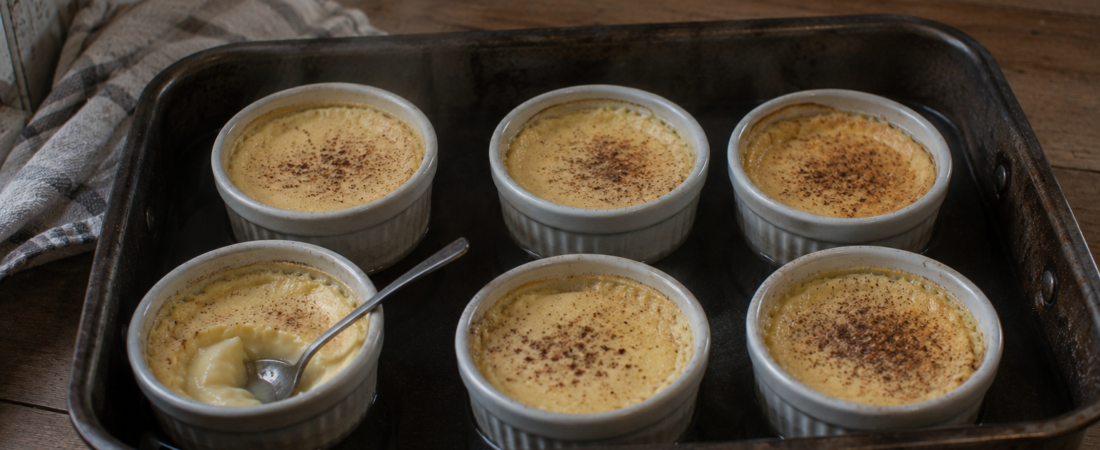
Old-fashioned baked egg custard, set slowly in a water bath and dusted with nutmeg.
When hens begin laying again in earnest, a household that had grown careful with eggs through the winter finds itself, briefly, with more than it knows what to do with. A custard was the sensible answer: plain, quick, and entirely dependent on an ingredient finally in generous supply.
It asked for little beyond eggs, milk, and a gentle hand with the oven. Set in a water bath and baked slowly, it rewarded patience with a texture smooth enough to eat with a spoon and no complaint from anyone at the table.
A custard was rarely the centerpiece of a meal. It was the quiet dish that filled the space between a modest supper and an early bedtime, nourishing and undemanding, welcome precisely because it asked for nothing extra.
Old-Fashioned Baked Egg Custard
MAKES
Serves 6
OVEN
325°F / 165°C / gas 3
TIME
35 to 40 minutes
Ingredients
- 5 large eggs
- ⅓ cup granulated sugar
- 2½ cups whole milk
- 1 teaspoon pure vanilla extract
- ¼ teaspoon salt
- Grated nutmeg, for the top
Method
- Preheat oven to 325°F (165°C). Place six small ramekins or custard cups in a deep baking pan.
- In a bowl, whisk eggs and sugar together until just combined, avoiding excess foaming.
- Warm milk gently in a saucepan until just steaming, not boiling.
- Slowly whisk warm milk into the egg mixture, adding gradually to avoid curdling.
- Stir in vanilla and salt.
- Strain mixture through a fine sieve for a smoother texture, if desired.
- Divide among ramekins. Sprinkle lightly with nutmeg.
- Pour hot water into the baking pan until it reaches halfway up the sides of the ramekins.
- Bake 35 to 40 minutes, until custard is set at the edges but still slightly trembling in the center.
- Remove ramekins from the water bath and cool before serving warm or chilled.
Where old-fashioned baked egg custard comes from
Egg custards were common across British and Maritime kitchens well before the nineteenth century, valued for their simplicity and reliance on ingredients most farm households kept on hand. In spring, with hens laying steadily after a lean winter, custards became a practical way to use eggs freely without waste.
Nutmeg, though imported, was used sparingly across many households and stretched a single purchase across a full season of baking. A custard dusted with it signaled a small, deliberate touch of care rather than expense.
In a modern kitchen
A water bath is essential for even, gentle cooking. Baking custard directly on an oven rack risks a curdled, rubbery texture.
Custards continue to set slightly as they cool, so remove them while the centers still hold a slight wobble.
How long it keeps
- Cool room: Refrigerate instead
- Refrigerated: 2 days
- Frozen: Do not freeze. The texture will not survive it.
Struggling to read an old recipe?
How to Read an Old Recipe translates the vague bits: old measures converted, oven descriptions in real degrees, and the instructions that leave something out. Free, two printable pages.
This recipe is one of forty-seven in The Green Gables Kitchen Companion, arranged across four seasons of a Prince Edward Island year. Everything on this site is written the same way it appears in the book.