
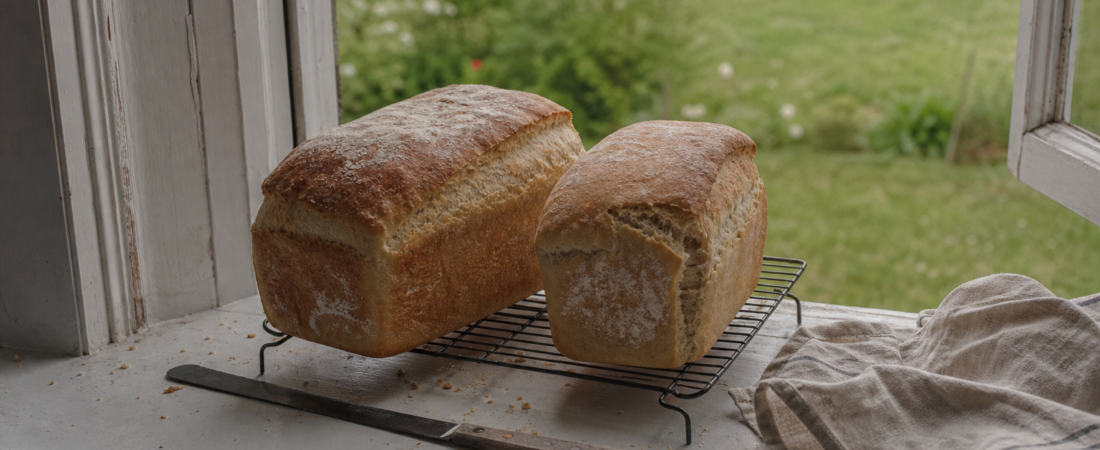
Homemade white bread, from a farmhouse recipe baked once or twice a week for a household that expected it.
No household could be called properly ordered without bread.
It stood at every meal, beneath butter, beside stew, under slices of cold meat, or toasted before the fire at day’s end. Cakes and puddings might delight, but bread sustained.
A white loaf, light and evenly risen, was a quiet point of pride. It required attention: yeast properly proofed, dough patiently kneaded, and rising time guarded from drafts and distraction. A careless loaf exposed itself at once, in a dense crumb, a pale crust, or a sour note no amount of butter could disguise.
Homemade White Bread
MAKES
2 small loaves or 1 large loaf
OVEN
375°F / 190°C / gas 5
TIME
25 to 45 minutes, plus rising
Ingredients
- 4 to 4½ cups all-purpose flour, plus more as needed
- 2¼ teaspoons active dry yeast (1 packet)
- 1½ cups warm milk, about 110°F / 43°C
- 2 tablespoons granulated sugar
- 1½ teaspoons salt
- 2 tablespoons unsalted butter, softened
Method
- In a small bowl, dissolve sugar in warm milk. Sprinkle yeast over the surface and let stand 5 to 10 minutes, until foamy.
- In a large bowl, combine flour and salt.
- Add yeast mixture and softened butter to the flour. Stir until a rough dough forms.
- Turn onto a floured surface and knead 8 to 10 minutes, until smooth and elastic.
- Place dough in a lightly greased bowl. Cover and let rise in a warm place until doubled in size, about 1 to 1½ hours.
- Punch down dough and shape into loaves.
- Place in greased loaf pans or on a baking sheet. Cover and allow to rise again until nearly doubled, about 45 minutes.
- Preheat oven to 375°F (190°C).
- Bake 25 to 30 minutes for two small loaves, or 35 to 45 minutes for one large loaf, until golden brown and hollow-sounding when tapped.
- Remove from pans and cool on a rack before slicing.
Where this homemade white bread comes from
By the late nineteenth century, white flour had become more widely available in Prince Edward Island, though whole and mixed-grain breads remained common. A white loaf signaled modest prosperity and careful housekeeping.
Commercial yeast, increasingly accessible, replaced earlier reliance on sourdough starters in many homes. Even so, success depended upon temperature control and attentive handling.
Bread was rarely purchased ready-made in rural communities. It was produced in quantity, often once or twice weekly, and stored carefully.
In a modern kitchen
Milk at 110°F is warm to the wrist, not hot. Milk hot enough to feel properly warm will kill the yeast and the dough will never rise.
Let it cool completely before slicing. A warm loaf cut too early has a gummy crumb, and it is the loaf’s fault far less often than the knife’s.
How long it keeps
- Cool room: 3 days, wrapped once completely cold
- Refrigerated: Not needed
- Frozen: 3 months
Struggling to read an old recipe?
How to Read an Old Recipe translates the vague bits: old measures converted, oven descriptions in real degrees, and the instructions that leave something out. Free, two printable pages.
This recipe is one of forty-seven in The Green Gables Kitchen Companion, arranged across four seasons of a Prince Edward Island year. Everything on this site is written the same way it appears in the book.