
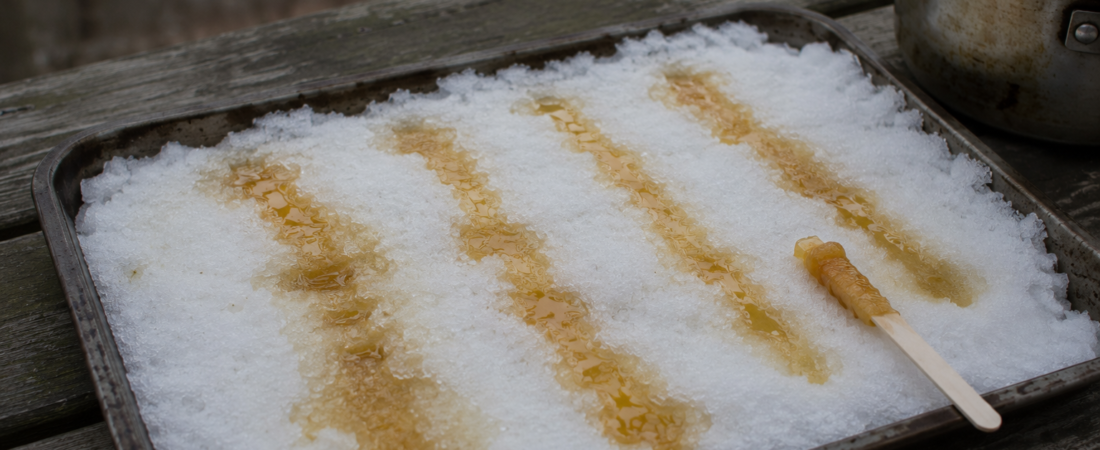
Maple taffy on snow, the spring treat that needs two ingredients, one of which is the weather.
There is a particular kind of spring evening when the sugar bush comes alive: the days warm enough to soften the crust of old snow, the nights still cold enough to keep a good bank of it in the shadow of the barn. Sap runs only in this narrow window, and an Island household with even a handful of maples nearby knew to watch for it.
Boiling maple syrup down to a taffy stage was less a recipe than an occasion. Children were sent out with bowls to pack fresh snow, and the syrup, poured hot in thin ribbons across the cold surface, seized almost at once into soft, chewy strands to be lifted on a fork and eaten standing in the yard.
It required no oven, no measuring beyond a careful eye on the thermometer, and no patience for anything but the syrup itself. It was, in every sense, a treat that belonged entirely to the season that made it possible.
Maple Taffy on Snow
MAKES
Serves 4 to 6 as a treat
OVEN
No oven. Stovetop
TIME
About 20 minutes
Ingredients
- 2 cups pure maple syrup
- A large bowl or tray of clean, tightly packed snow, or crushed ice
Method
- Pack a wide bowl, tray, or clean baking sheet firmly with snow. Set in the coldest part of the kitchen or just outside the door.
- Pour maple syrup into a deep, heavy saucepan. It will bubble up considerably as it boils.
- Bring to a boil over medium heat, stirring occasionally.
- Continue boiling, without stirring, until the syrup reaches 235°F to 240°F, the soft-ball stage, on a candy thermometer.
- Remove from heat immediately.
- Drizzle hot syrup in thin ribbons directly onto the packed snow, working quickly before it cools.
- Allow to sit 20 to 30 seconds, until just firm enough to lift but still pliable.
- Lift each ribbon with a fork or wooden stick and eat at once, before it hardens further.
Where maple taffy on snow comes from
Maple sugaring was one of the oldest food traditions on the Island, adapted from practices long established among the Mi’kmaq and carried forward by settler households who learned to read the sap runs of early spring. A sugar camp, however modest, marked one of the first communal gatherings after a long, isolated winter.
Taffy on snow required no equipment beyond a pot and patience, which made it accessible even to households without a proper sugar house. It was less a dessert than a ritual, a way of marking the precise, narrow moment when winter began to loosen its hold.
In a modern kitchen
If snow is unavailable, finely crushed ice packed tightly in a shallow tray works nearly as well.
A candy thermometer removes the guesswork. Without one, test by dropping a small amount of syrup into ice water, which should form a soft, pliable ball.
How long it keeps
- Cool room: Eat at once. This does not keep and is not meant to.
- Refrigerated: Not needed
- Frozen: Do not freeze
Struggling to read an old recipe?
How to Read an Old Recipe translates the vague bits: old measures converted, oven descriptions in real degrees, and the instructions that leave something out. Free, two printable pages.
This recipe is one of forty-seven in The Green Gables Kitchen Companion, arranged across four seasons of a Prince Edward Island year. Everything on this site is written the same way it appears in the book.